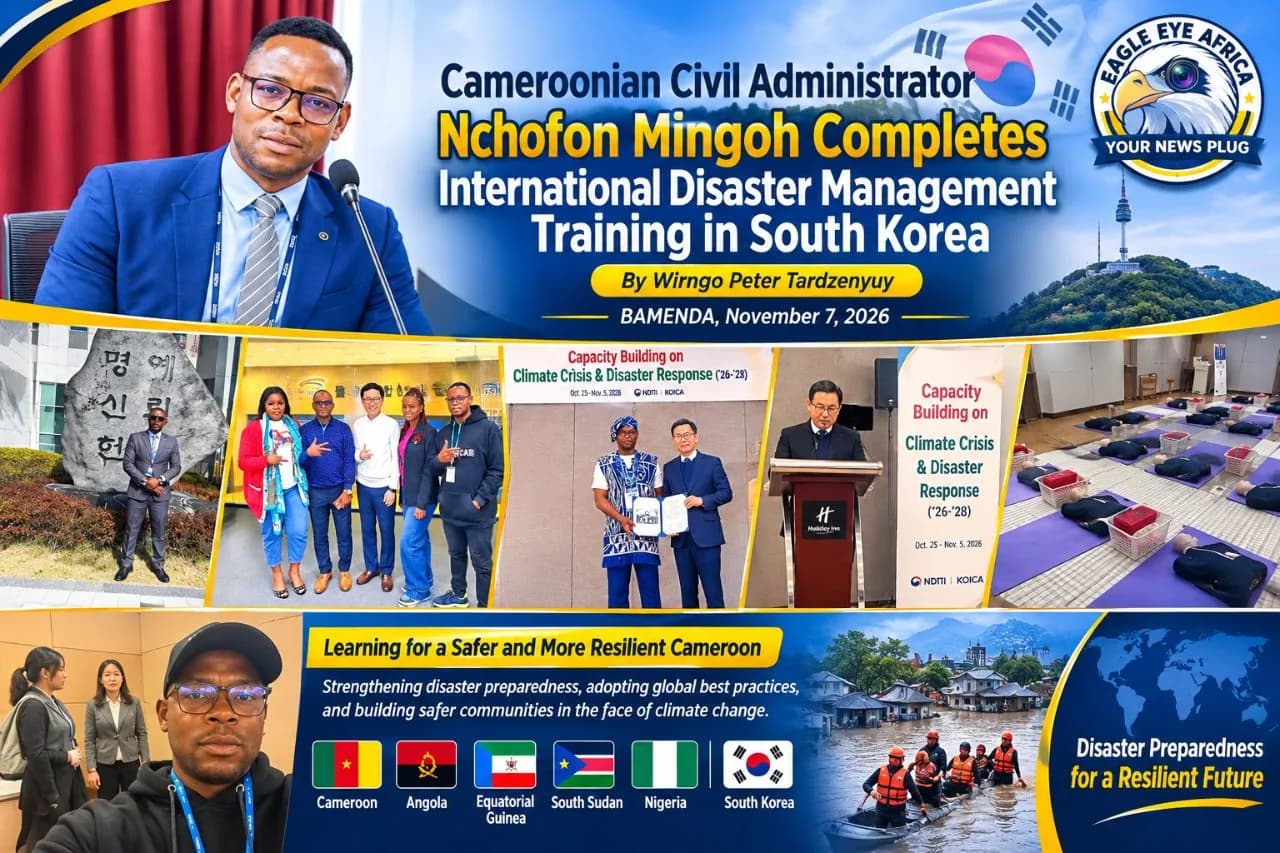
Cameroonian Civil Administrator Nchofon Mingoh has completed a two-week international training programme on Climate Crisis and Disaster Response in the Republic of Korea, joining participants from five other African countries in a programme aimed at strengthening disaster preparedness and management.
The training, which ran from October 25 to November 5, 2026, was organised by South Korea’s National Disaster Training Institute (NDTI), with support from the Korea International Cooperation Agency (KOICA).
Participants came from Cameroon, Angola, Equatorial Guinea, South Sudan and Nigeria. The programme provided an opportunity to study South Korea’s approach to disaster prevention, emergency response, climate risk management and recovery after disasters.
Mingoh, who is involved in coordinating humanitarian assistance in Cameroon’s North-West Region, was among the Cameroonian participants who took part in the programme.
A major part of the training focused on South Korea's experience in managing natural disasters, particularly flooding and other climate-related emergencies.
Participants examined the country's early warning systems, emergency coordination structures, flood control measures, urban drainage systems and post-disaster recovery arrangements.
The discussions also highlighted the importance of preventing disasters before they happen, rather than waiting for emergencies to occur before taking action.
These lessons have particular relevance to Cameroon, where flooding, landslides and other environmental hazards continue to affect communities, infrastructure and livelihoods.
The programme also covered the Sendai Framework for Disaster Risk Reduction (2015–2030), an international framework that guides countries in reducing disaster risks and building safer communities.
Participants examined four key areas: understanding disaster risks, improving disaster management institutions, investing in prevention and strengthening preparedness for effective response and recovery.
Another important subject was the principle of Build Back Better, which encourages authorities to rebuild communities in ways that reduce their vulnerability to future disasters instead of simply restoring what was lost.
For Cameroon, this approach could be useful in areas affected by flooding, landslides, armed conflict and displacement, where humanitarian assistance increasingly needs to go hand in hand with rehabilitation and the restoration of livelihoods.
The knowledge gained from the training points to several areas where Cameroon could strengthen its disaster management system. These include better coordination among administrative authorities and technical services, improved community early warning systems, regular emergency simulation exercises and stricter respect for urban planning regulations.
There is also a need to strengthen the operational capacity of the Department of Civil Protection and improve collaboration between government services, councils, humanitarian organisations, traditional authorities and local communities.
These measures are particularly important in the North-West and South-West Regions, where humanitarian challenges and environmental risks often place additional pressure on local authorities and communities.
Mingoh's participation is significant given his involvement in humanitarian assistance in the North-West Region. The experience offers an opportunity to share knowledge acquired during the training and explore how some of the practices observed in South Korea can be adapted to Cameroon's realities.
The participation of the six African countries also provided an opportunity for participants to exchange experiences and discuss common challenges facing their respective countries.
As Cameroon continues to deal with humanitarian emergencies and the growing effects of climate change, stronger disaster prevention, preparedness and response mechanisms remain essential.
The South Korean training has given the participating Cameroonian officials additional exposure to international approaches that could help improve disaster management and contribute to the protection of lives and property.