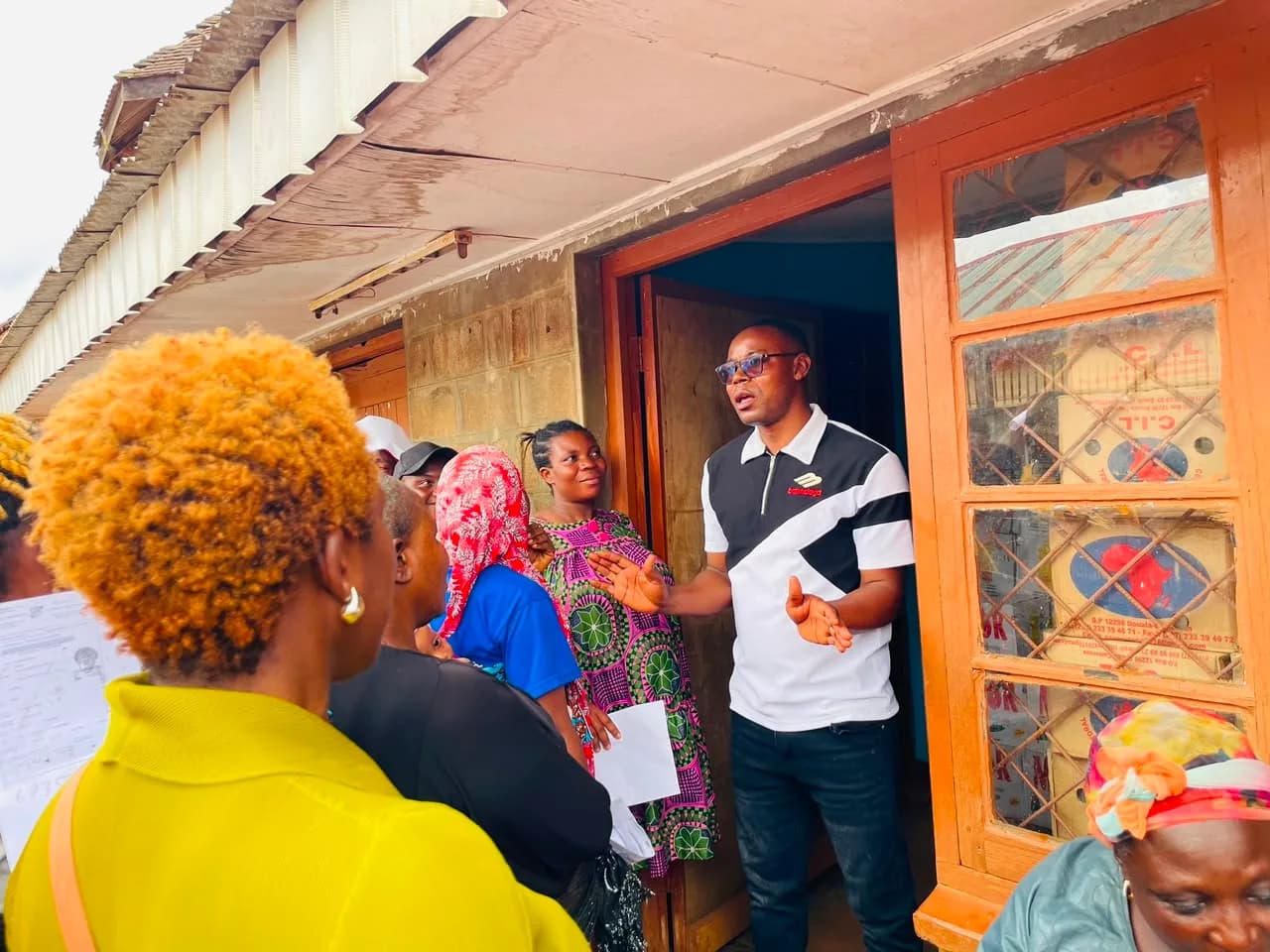

Calls for stronger border security, employment opportunities for young people, better access to education and greater community participation dominated reactions from traditional and community leaders, women and youth representatives during Prime Minister Chief Dr. Joseph Dion Ngute’s peace dialogue at the Bamenda Congress Hall on Thursday, October 15, 2026.
The exchanges brought the concerns of communities directly affected by the conflict in the North West Region before the head of government, with speakers insisting that lasting peace will require more than security operations.
From Menchum, Bui, Ngoketunjia , Momo, Boyo, Mezam and Donga-Mantung, participants described the difficulties facing families, schools, businesses and transporters, while proposing measures they believe could help restore confidence and encourage armed youths to return to civilian life.
The North West President of the Cameroon National Youth Council (CNYC) Mekom Samuel Taleh, called for direct engagement with armed youths, arguing that local communities often know those involved in the violence and could help persuade them to abandon their weapons.
“All of us know them. In our communities, in our villages … we know them. We have to talk to them,” Taleh told the gathering.
He urged the government to create channels through which trusted community representatives could hold frank discussions with combatants and encourage them to leave the bushes.
However, he also called for a two-month deadline for those unwilling to surrender their weapons, after which the government should take immediate action against those who continued to pose a threat.
Taleh said the focus on youths involved in armed violence should not overshadow the much larger number of young people who remain peaceful but struggle with unemployment and limited opportunities.
He described the situation as one in which young people who have chosen peace are also being left behind, calling for deliberate efforts to provide them with meaningful work.
His intervention placed economic opportunity alongside security as a central issue in the search for peace.
Another speaker from Menchum Division argued that unemploymaent and years of perceived neglect had contributed to the frustration among young people.
He called for the reopening of the WADA facility in Wum, recalling that it opened in 1983 and once employed about 7,000 workers before its closure.
According to the speaker, reviving the facility could provide jobs for young people in Wum and surrounding communities, while giving those involved in the conflict a practical reason to reconsider their decision to take up arms.
He told the Prime Minister that creating 1,000 jobs could help him persuade 1,000 combatants to return to civilian life, illustrating the role employment could play in encouraging disarmament.
The appeal reflected a wider concern expressed during the dialogue: that peace initiatives would struggle to produce lasting results if young people continued to face limited prospects for earning a living.
Security along the border with Nigeria featured prominently in an intervention representing communities in Menchum, particularly the Furu-Awa and Baworo stretches.
The speaker compared efforts to address insecurity without tackling its underlying causes to repeatedly cleaning water from a floor without repairing a leaking roof.
He warned that the porous border provided routes for the alleged smuggling of weapons and *odeshi*, a substance associated in local accounts with claims of spiritual protection or invulnerability among some fighters.
While acknowledging the security presence in Furu-Awa , he called for reinforcements in both areas and the deployment of adequately equipped security personnel to Baworo, which he described as lacking a security presence.
He said the government had previously been expected to deploy forces to the Baworo stretch but that the community was still waiting.
The speaker argued that strengthening security along these routes would help restrict the movement of weapons into the North West Region.
His appeal was accompanied by a demand for better learning conditions, following reports that enrolment in some schools had increased sharply without a corresponding expansion in infrastructure.
He cited a technical school whose enrolment had reportedly risen from about 300 to nearly 1,000 students, leaving some learners without benches or adequate classroom space.
He urged the government to make education more attractive and accessible so that children would have stronger reasons to remain in school rather than be drawn into armed groups.
A representative speaking on behalf of workers in Bui told the Prime Minister that insecurity continued to affect virtually every sector of local life.
He identified education, business and transportation among the areas facing difficulties, arguing that improved security would allow the division to function more like other parts of the country.
The speaker raised concerns about the future of children in Kumbo, referring to the transfer of more than 600 teachers out of the division and the pressure facing schools despite what he described as strong academic results.
He also relayed concerns from drivers and other transport operators over insecurity on the roads, calling for increased security deployment to help restore confidence in travel.
The representative further requested the return of the Social Insurance Fund services from Nkambe to Kumbo, saying the move would make it easier for pensioners to process documents and access services.
He also referred to plans to organise youth training and empowerment activities that had been affected by insecurity, arguing that continued instability was preventing communities from taking advantage of economic opportunities.
Women representatives used the dialogue to highlight the burden the crisis has placed on mothers and families.
One speaker said women were often caught between armed youths, security concerns and the hardship experienced by communities. She rejected the idea that mothers could simply control the decisions their children make after leaving home and interacting with others.
“Any bad child, any armed child is a child of a Menchum woman,” she said, describing the emotional and social cost borne by mothers.
She also drew attention to farmer-grazer conflicts, which she said had resulted in deaths, displacement and the loss of livelihoods. The speaker warned that longstanding tensions could reopen old wounds and create fresh problems for already vulnerable communities.
She urged the government to train women in conflict resolution and community dialogue so that they could take a more active role in addressing disputes within their villages.
The call was echoed by a representative of Network Women, who said women were already speaking with and counselling young people in an effort to persuade them to abandon armed violence.
She argued that women should not automatically be blamed whenever their children become involved in the conflict, insisting that mothers were also working to prevent further destruction in their communities.
Another women’s representative said community dialogue must begin in the home before extending to neighbourhoods and villages.
She called for women to receive at least 50 per cent representation in peacebuilding initiatives, arguing that their influence within families and communities could help persuade combatants to return home.
The women also called for practical empowerment programmes, including access to training centres and activities that would help them earn a living. They maintained that economic support would strengthen their ability to contribute to peace efforts.
The role of traditional authorities emerged as another recurring theme.
A stakeholder who referred to community dialogue initiatives in Nkambe said traditional rulers had an important part to play in bringing together quarter heads, youth leaders, religious authorities, elders and other influential members of society.
He recalled that violence should not be allowed to destroy communities or their cultural foundations.
“Our community cannot be destroyed by violence. Our culture cannot be destroyed by violence. Our people must speak in unity, no matter the difficulties,” the speaker said.
He urged the government to empower traditional rulers to organise and lead community dialogue across divisions and subdivisions, arguing that people continued to turn to their palaces for guidance and resolution of disputes.
The proposal was consistent with Taleh’s call for trusted local leaders to be given the opportunity to engage directly with armed youths.
Speakers maintained that community-level reconciliation would be more effective when local institutions were actively involved rather than relying exclusively on decisions taken at higher administrative levels.
Taleh also called on churches to examine the messages being delivered to congregations during the crisis.
He accused some pastors and priests of preaching hatred and presenting the conflict as a divine cause, warning that such messages could encourage young people to remain on a destructive path.
He urged religious leaders to use their pulpits to condemn violence, promote reconciliation and remind their followers of the harm the conflict was causing communities.
His appeal placed responsibility for peacebuilding not only on government and security authorities but also on institutions that influence public opinion and shape the values of young people.
The Disarmament, Demobilisation and Reintegration (DDR) programme also featured in Taleh’s intervention.
He urged the authorities to accelerate the reintegration of people who had chosen to leave armed groups, arguing that delays in helping them return to society could discourage others who were considering the same decision.
Taleh said those who had completed training needed opportunities to rebuild their lives and demonstrate to others that the programme offered a credible route back into civilian society.
He encouraged community representatives who had contact with armed youths to explain the process and reassure them that reintegration could provide a path towards a new beginning.
His position highlighted the importance of linking disarmament with practical support, employment and acceptance within communities.
The interventions at the Bamenda Congress Hall revealed both the urgency of the security situation and the range of social and economic problems that stakeholders believe must be addressed to secure lasting peace in the North West Region.
Participants called for stronger protection of vulnerable border communities, improved road security, renewed economic activity, better school facilities and more opportunities for young people. Women demanded meaningful participation in peace initiatives, while traditional rulers and religious leaders were urged to use their influence to rebuild trust.
The requests now place the focus on how the government and local stakeholders will respond to the concerns raised.
For communities that have endured years of insecurity, displacement and disrupted education, the expectations extend beyond the dialogue itself. They include safer roads, functioning schools, jobs for young people and credible opportunities for those willing to abandon violence.
The challenge following Thursday’s meeting will be to turn those demands into practical measures that communities can see and feel in their daily lives.
Eagle Eye Africa
Wirngo Peter Tardzenyuy