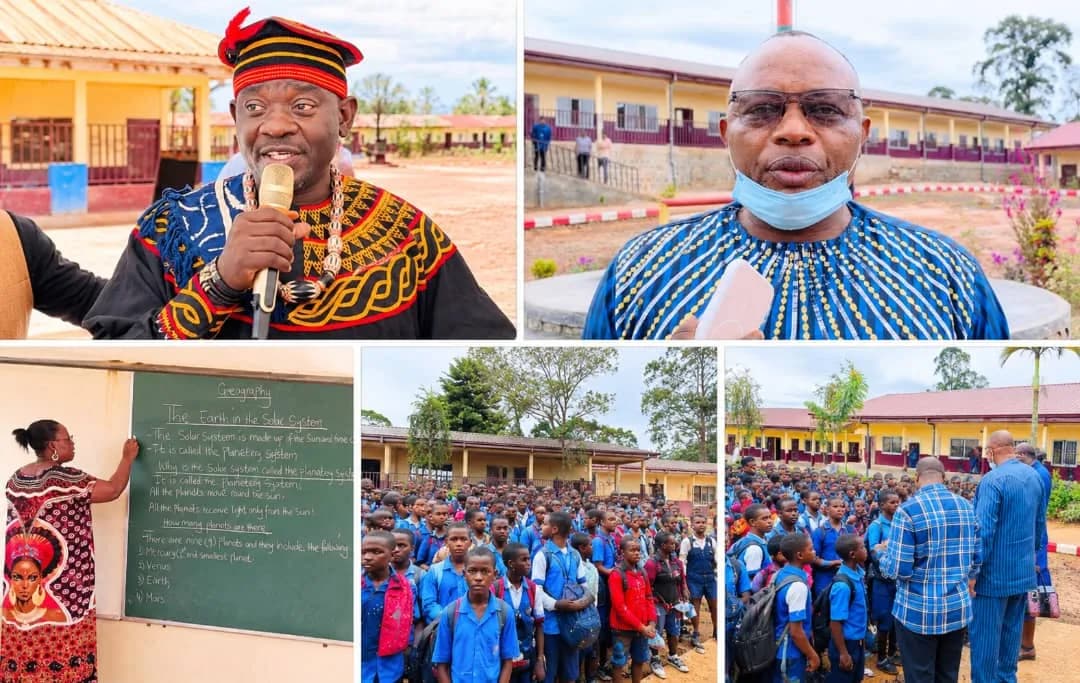

For many years, families from Cameroon’s Francophone regions sent their children to Bamenda and other towns in the North West Region in search of an Anglo-Saxon education. Today, amid years of conflict and school disruption, that movement has increasingly been reversed, with Anglophone families travelling to Douala and other cities to keep their children learning.
For Rev. Engr. Mekom Samuel Taleh, an educationist from Bamenda and proprietor of Compétence Bilingual Nursery and Primary School in Bonapriso, Douala, the shift is more than a change in where children attend classes. It is a challenge to preserve an educational tradition that he believes must remain accessible to future generations.
Speaking in an interview with Eagle Eye Africa, Taleh described how the crisis in the North West and South West Regions motivated him to establish a school that could serve displaced Anglophone children while also welcoming Francophone pupils seeking a bilingual education.
## From Bamenda to Douala: Education Finds a New Home
Taleh says his commitment to the Anglo-Saxon system is rooted in his own experience. He completed his education from nursery school through university within the system, an experience that shaped his belief in the importance of English-language instruction and a strong academic foundation.
“I did my nursery school, primary, secondary, high school, and university all in an Anglo-Saxon setup,” he explained.
But as the crisis intensified and schooling became increasingly difficult in parts of the North West and South West Regions, he became concerned about children whose education had been interrupted and families who could no longer access the schools they once relied on.
Compétence Bilingual Nursery and Primary School was founded in 2017 after Taleh obtained authorisation from the Ministry of Basic Education. He initially expected about 100 pupils. Instead, he said, enrolment reached nearly 450 in the school's first year, including both Anglophone and Francophone children.
The response convinced him that the school needed to accommodate both communities.
“We had to make the school bilingual so that we can incorporate both the Francophone and the Anglophone system of education,” he said.
For Taleh, the objective is not simply to teach children in English and French, but to ensure that pupils leave primary school able to communicate confidently in both languages and function effectively in society.
## The Cost of Preserving an Education
For displaced families in Douala, the search for schooling comes with competing financial demands. Rent, food, transportation and other living expenses can leave parents struggling to meet school fees while trying to rebuild their lives away from home.
Taleh says affordability was one of the main reasons for establishing his school. He puts the annual school fees at 50,000 FCFA for primary pupils and 60,000 FCFA for nursery pupils.
He insists that the institution was created primarily to serve Displaced children rather than generate profit.
“We did not create the school for money; we created the school to serve humanity,” he said.
According to Taleh, more than 80 pupils ended the previous school year with outstanding fees, but the school allowed them to continue learning rather than send them away.
The experience highlights a wider dilemma for families displaced by the conflict: how to preserve access to the education they want for their children when the cost of living in their places of refuge is already high.
Taleh's account also raises an important question for education stakeholders: what practical support can help displaced children remain in school without placing an unbearable burden on their parents?
## Quality Beyond the Classroom
As schools serving displaced communities expand in urban centres, concerns have been raised about the quality of facilities, teacher preparation and opportunities for extracurricular development.
Taleh rejects the suggestion that his institution is simply a residential building converted into a school. He says Compétence Bilingual has an IT and computer laboratory, a library and an innovation centre intended to support pupils' learning and development.
A trained technical-school and IT teacher himself, he says he wants pupils to gain exposure to skills and resources that were not always available to earlier generations of students.
He also points to the school's reported 100 per cent pass rate in the Common Entrance and First School Leaving Certificate examinations. These results, he says, reflect the institution's commitment to academic standards in both its Anglophone and Francophone sections.
## Moral Values and Religious Inclusion
Taleh says character development is another part of the school's approach. Daily morning devotions and lessons on civic responsibility and ethical values are intended to encourage discipline and responsible conduct among pupils.
Despite his background as an ordained reverend, he says the school also makes provision for Muslim pupils. According to him, more than 100 Muslim children attend the institution, and a dedicated prayer space allows them to observe their daily prayers.
His position, he explained, is that children from different religious backgrounds should have the opportunity to learn in an environment where their faith is respected.
## A Message to Parents and Those Preventing School Attendance
The most urgent part of Taleh's message concerns children whose schooling remains disrupted in the conflict-affected regions.
He appealed to parents to prioritise formal education, arguing that practical skills acquired at a young age cannot replace the basic academic knowledge children need to understand and apply those skills.
“A society that stops students from going to school is a society that is willing to raise monsters, to raise terrorists, to raise bandits,” he warned.
He also addressed armed separatists and others involved in preventing school attendance, urging them to reconsider actions that deny children access to education.
For Taleh, the consequences extend far beyond missed lessons or examinations. A prolonged interruption can leave children without the qualifications and technical knowledge required to pursue professional opportunities later in life.
His appeal comes against the backdrop of years of school disruption in the North West and South West Regions, where insecurity and school boycotts have affected access to education. The situation varies from community to community, but the consequences for children and families remain a major concern.
## Plans to Return to the North West
Although Compétence Bilingual currently operates in Douala II Municipality, Taleh says he has not abandoned the idea of returning the school to be base in the North West Region.
## Can Anglo-Saxon Education Recover Its Ground?
Taleh's experience reflects a difficult contradiction in Cameroon’s education landscape. In Douala, displaced families are seeking schools capable of maintaining the English-language educational tradition they value. In parts of the North West, the same tradition faces the challenge of interrupted schooling, insecurity and uncertainty about the future.
Keeping that system alive in exile may help individual children continue their education, but it does not remove the need to restore safe and reliable access to schooling in the communities from which many of them came.
For parents, educators and public authorities, the challenge is twofold: support children who have had to move in search of education and create conditions that allow those who remain at home to return to the classroom.
Taleh believes the answer begins with ensuring that children are not denied the opportunity to learn.
His school in Bonapriso represents one response to that challenge. For now, he says, the priority is to keep children learning and preserve the educational foundation they will need for the future.