
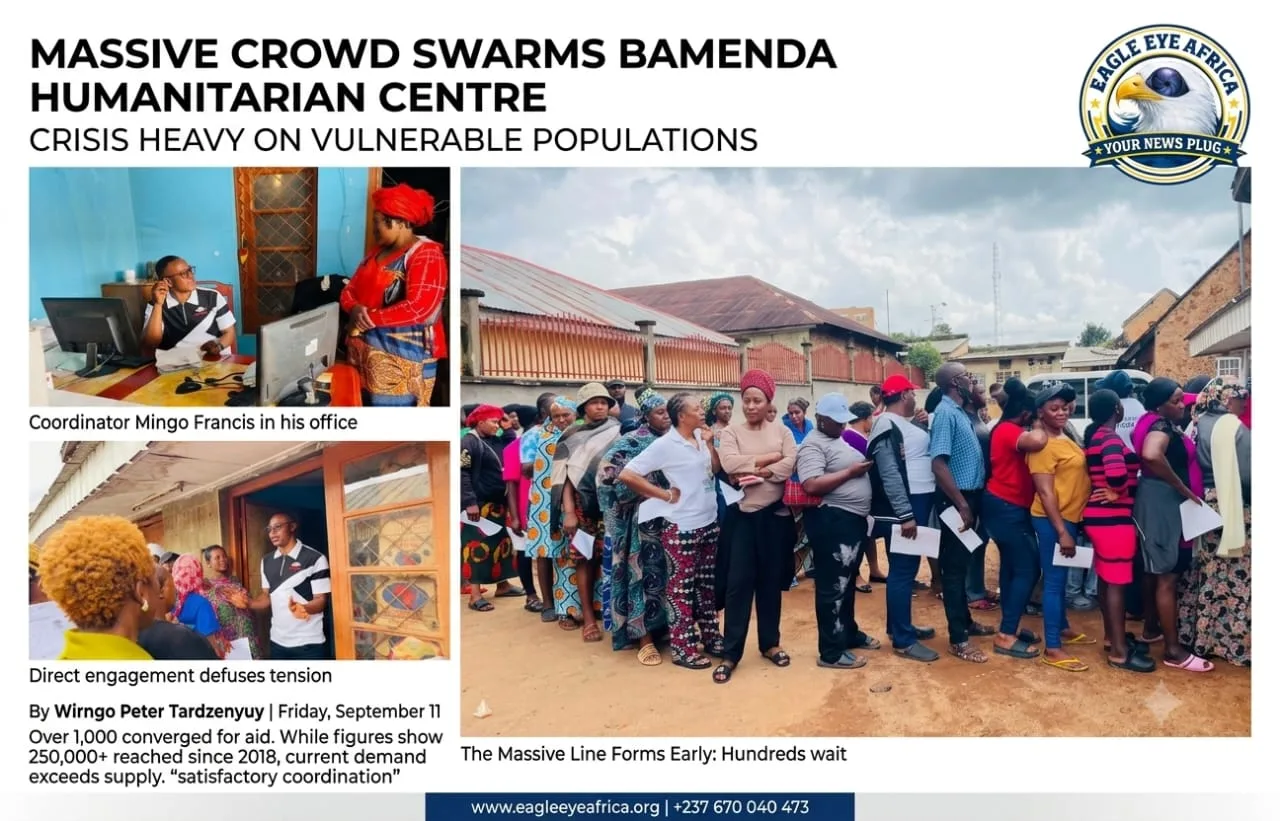
The persisting humanitarian strain in Cameroon's North West Region was laid bare on Friday, September 11, when over 1,000 internally displaced persons (IDPs) and vulnerable residents flooded the Government Emergency Humanitarian Assistance Centre in Bamenda in search of relief.
Arriving in the early hours of the morning, men, women, and elderly citizens converged on the facility, highlighting the deep dependence of thousands of families on emergency assistance to survive the fallout of the protracted conflict.
Established in 2018 by Prime Ministerial order on instructions from President Paul Biya, the Bamenda Emergency Humanitarian Assistance Centre remains the central hub of the state's response to the crisis. Nationally coordinated by Paul Atanga Nji, Minister of Territorial Administration, the facility has reportedly reached over 250,000 beneficiaries to date with basic foodstuff, non-food household items, and cash grants.
Despite these figures, the scene on Friday underscored a stark reality: local demand for emergency assistance continues to outpace available supplies.
The influx put immense pressure on facility personnel, but observers noted that the situation was kept under control through deliberate engagement by the centre's leadership.
Nchofon Mingoh, Assistant Divisional Officer for Bamenda I Subdivision, who doubles as head of the centre, opted for direct dialogue with the crowd rather than administrative retreat. Mingoh engaged the gathering directly, outlining current operational limits and detailing distribution timelines.
The open communication appeared to defuse potential friction among a crowd operating under stressful conditions.
"Though we were not given any assistance today, I am still very satisfied at how the coordinator explained things to us," noted one internally displaced person present at the scene.
For relief workers on the ground, the morning's events demonstrated that clear communication remains as vital as material distribution when managing vulnerable populations during an ongoing emergency.
Metric / Category Details
Total Beneficiaries Reached Over 250,000 persons since 2018
Primary Food Supplies Rice, vegetables, cooking oil, sugar, sardines
Essential Non-Food Items Mattresses, blankets, buckets, soap, toothbrushes, toothpaste, toilet paper
Financial Support Direct cash assistance scheme Operational Leadership Nchofon Mingoh (Head of Centre / Assistant DO Bamenda I) National Coordination Paul Atanga Nji (Minister of Territorial Administration)
The events of September 11 highlight a complex balance for local authorities: while government relief efforts have reached hundreds of thousands over the past eight years, displacement, loss of livelihoods, and economic instability continue to generate new demand.