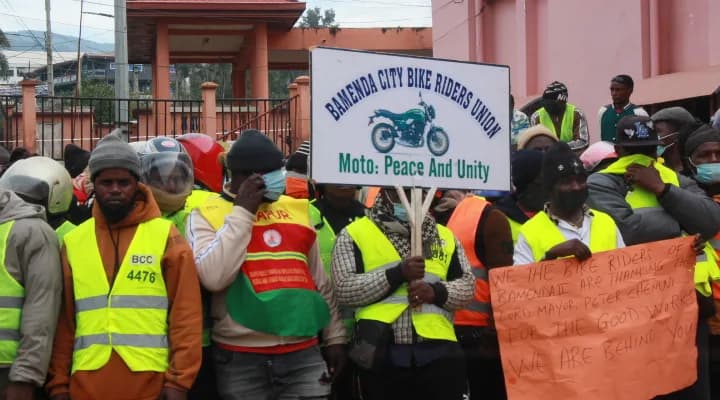
Commercial bike riders in Mezam Division are scrambling to regularise their activities ahead of November 1, when administrative measures aimed at tightening control over the sector are expected to be enforced more strictly.
For thousands of riders who depend on motorcycle transport to earn a living, the deadline comes with growing concerns over the cost of documentation, the restriction to one passenger per bike and the consequences of failing to comply.
The measures form part of the administration's efforts to address security concerns in Bamenda and other parts of the North West Region, where commercial motorcycles have repeatedly come under scrutiny amid the ongoing Anglophone crisis.
During a meeting with Minister of Territorial Administration Paul Atanga Nji at the MINEPAT Hall in Bamenda, bike riders were reminded of the need to comply with administrative instructions, including the regularisation of their documents and the one-passenger-per-motorcycle rule.
The latest push follows years of restrictions and enforcement operations targeting motorcycle circulation in parts of Bamenda. In 2023, security authorities compounded bikes belonging to riders accused of violating circulation restrictions imposed in certain areas of the city.
Since then, the sector has continued to operate under difficult conditions, with some riders caught between government security measures and threats associated with the armed conflict. Reports of killings, torture and motorcycles being burnt have added to the difficulties faced by those who depend on the activity for their livelihood.
Only 20 Per Cent Registered, Says Mezam Bike Riders Union
With the November 1 deadline approaching, the Mezam Bike Riders Union says only a fraction of its members have completed the registration process.
Etua Ebot Jeremiah, Secretary General of the union, estimates that about 20 per cent of commercial bike riders in Mezam have so far registered with the union and obtained the necessary documentation.
He puts the number of riders operating across the division at approximately 10,000, although the figure has not been independently verified.
According to him, the process is moving slowly because many riders face financial difficulties, particularly those operating motorcycles acquired through hire-purchase arrangements.
Some riders, he explained, must make daily payments to the owners of the motorcycles they operate, leaving them with little money to meet the cost of obtaining their own documents.
Jeremiah is appealing to the administration to grant riders additional time to comply, arguing that a gradual approach would give the union an opportunity to organise its members and help them complete the process.
He has proposed a collective contribution system through which riders could make weekly or monthly payments towards the cost of their documentation.
The union official also called for government assistance to reduce the financial burden on riders.
According to him, obtaining the necessary documents can cost a rider about FCFA 70,000 when the different requirements are added together, making compliance difficult for those already struggling to support their families.
He further appealed for assistance in providing motorcycles to the union, saying such support could help the organisation generate income and assist members who cannot afford the cost of regularisation.
Beyond the cost of compliance, Jeremiah says some riders have lost confidence in the process because of what he describes as harassment at security checkpoints.
He recounted instances in which riders who presented their documents were allegedly asked to pay money before being allowed to continue their journeys.
For him, such experiences undermine efforts to encourage compliance and make it harder to convince other riders that obtaining the required documents will protect them from unnecessary difficulties on the road.
The union says it has spent years trying to organise commercial riders through local parks and junctions, where designated park leaders help identify those operating in their respective areas.
The arrangement, according to Jeremiah, is intended to make it easier to distinguish recognised commercial riders from people who may infiltrate the sector for criminal purposes.
He believes registration, proper documentation and identifiable uniforms or council-issued aprons could help restore public confidence in motorcycle transport.
The union has also welcomed the opportunity to obtain 100 membership plates following discussions with the Minister of Territorial Administration, describing the gesture as a step towards improving identification within the sector.
While the documentation requirement remains a major concern, the restriction to one passenger per motorcycle is another measure riders say could affect their daily earnings.
For many commercial riders in Bamenda, carrying two passengers on a single trip has been a common way of making ends meet, particularly over short distances.
Jeremiah says the return to one passenger per motorcycle could force riders to make more trips to earn the same amount of money, at a time when fuel prices and household expenses continue to put pressure on their incomes.
He also points to situations in which parents travel with their children, saying the restriction could create practical difficulties for families going to school, hospital or other destinations.
Despite these concerns, the union secretary general acknowledged that carrying one passenger is consistent with the applicable motorcycle transport categories.
He said riders would eventually have to adapt if the authorities insist on strict enforcement, but appealed for understanding as members adjust to the new requirements.
Another rider, Luis Mota, also expressed concern about the restriction, saying it was already affecting his ability to earn a living.
His comments reflect the uncertainty among some operators who fear that fewer passengers per trip could further reduce their income.
The North West Regional Delegation of Transport Emmanuel Nji Asanji says its responsibility is to facilitate the issuance of transport documents and conduct road controls to identify and sanction illegal transport activities.
In responses to questions from Eagle Eye Africa, Emmanuel Nji Asanji the Regional Delegate explained that motorcycles registered in Bamenda are not necessarily used exclusively within the city. Consequently, the delegation cannot provide a reliable count of motorcycles circulating in the area or the number operating without registration.
The delegate also clarified that the registration of a new motorcycle requires proof of purchase of its number plate.
On the documents required for commercial motorcycle activity, the delegation listed the registration certificate at FCFA 5,000, a Category A driving licence at FCFA 11,500 for successful candidates, and the number plate at FCFA 7,000.
The delegate added that, alongside the eight ordinary driving tests organised each year, special Category A licence examination sessions are regularly arranged to accommodate the high number of applicants.
For riders who fail to regularise their motorcycles, the consequences could be costly.
According to the Regional Delegate, any motorcycle found to be irregular will be impounded. A fee of FCFA 25,000 will be charged for its release, with an additional FCFA 5,000 for every extra day it remains impounded.
The clarification places further pressure on riders who are yet to complete their paperwork, particularly those who say they are struggling to raise the required funds.
On the question of children travelling on motorcycles, the Regional Delegate explained that a child under the age of majority would not be considered a passenger for the purpose of the one-passenger restriction.
However, both the accompanying adult and the child must wear safety helmets, and no more than one child may accompany the adult under the conditions outlined by the delegation.
Parents travelling with several children are advised to consider using a taxi instead.
The explanation offers some clarification for families who rely on motorcycles for everyday transport, although the practical implications of the rule will become clearer as enforcement progresses.
The Regional Delegate described motorcycle transport as a useful means of reaching isolated and hard-to-access communities but said it was not intended to remain a permanent mode of public transport in urban areas.
As road rehabilitation continues in Bamenda, the authorities expect taxi services to expand, with public transport by bus also envisaged as the city develops.
For now, however, motorcycles remain an important means of mobility for many residents, particularly in neighbourhoods where access to conventional public transport is limited.
The challenge will be finding a balance between the administration's security concerns and the economic realities of those who depend on the sector.
For commercial bike riders in Mezam, the November 1 deadline represents more than a regulatory change. It is another test for a sector that has struggled to survive amid insecurity, financial hardship and years of restrictions.
The administration maintains that proper documentation and compliance with transport regulations are necessary to improve control over motorcycle activities and address security concerns.
The riders, for their part, are not rejecting regulation outright. Their concerns centre largely on affordability, the time needed to comply and the effect of stricter operating conditions on their livelihoods.
With enforcement expected to intensify, the coming days will show how many riders are able to meet the requirements and how the authorities respond to those who fall short.
For a sector employing thousands of people directly or indirectly, the outcome will have consequences that extend beyond the motorcycle parks and onto the streets of Bamenda, where riders and passengers alike depend on the service every day.