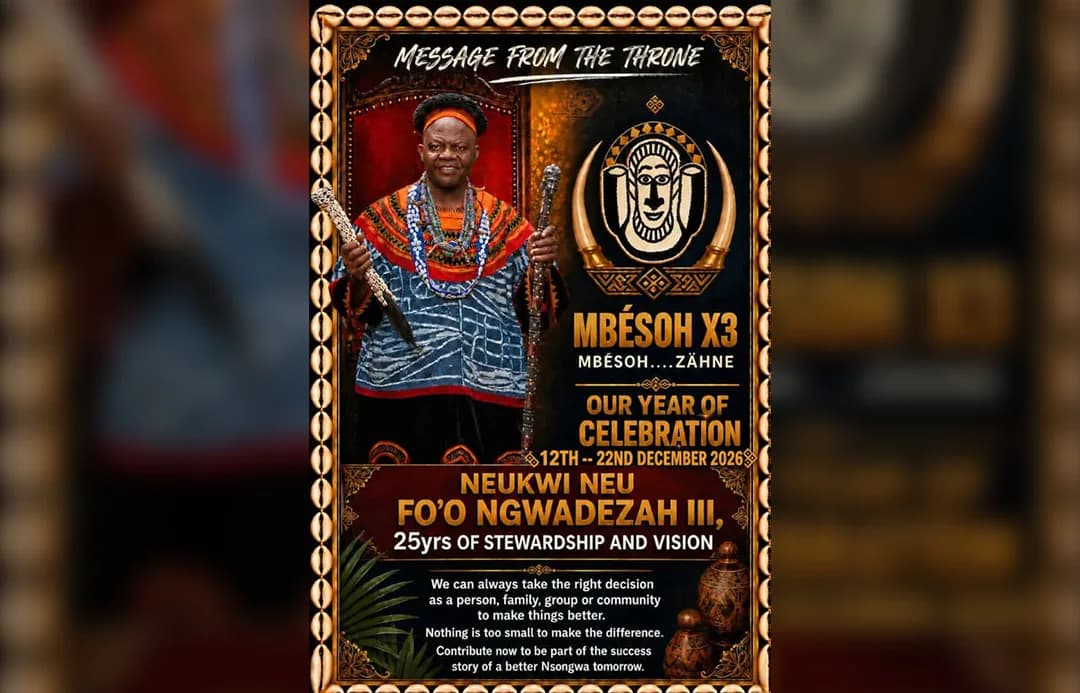
Nsongwa is preparing to welcome sons and daughters of the village, traditional authorities, administrative officials and other well-wishers for a 10-day cultural celebration marking the 25th anniversary of the enthronement of His Royal Majesty Fo’o Ngwadeza III.
The celebration, known as Neukwi neu Fo’o Ngwadeza III, is scheduled for December 12 to 22, 2026. Organisers say the event will provide an opportunity for the community to reflect on its development, preserve its cultural heritage and strengthen ties among its people.
Located in Bamenda II Subdivision of Mezam Division in Cameroon's North West Region, Nsongwa shares boundaries with Chomba, Mbatu, Mankon and Bali. The forthcoming celebration is expected to draw visitors from neighbouring communities, other parts of the country and the diaspora.
In interviews ahead of the festival, the Fon of Nsongwa, the President General of the Nsongwa Development and Cultural Association (NDECA), and the Chairman of the Nsongwa Traditional Council outlined their expectations and appealed for continued community participation.
Reflecting on his 25 years on the throne, Fo’o Ngwadeza III recalled the difficulties Nsongwa faced when he assumed traditional leadership. He said the village had lacked basic amenities, including roads, water and electricity, while its palace infrastructure was also limited.
The Fon attributed the progress made since then to the support and collaboration of the community, including young people and children. He said the changes had given the village reasons to take pride in what it has achieved.
“We can proudly say that we have become a star village,” he said, expressing gratitude to the people for supporting his leadership and maintaining the traditions inherited from their forefathers.
For the Fon, however, the meaning of Neukwi goes beyond marking the passage of 25 years. He described it as a celebration of growth in different aspects of life, including wisdom, spiritual development, intelligence and financial progress.
He said the celebration would bring people together to appreciate the community's achievements while welcoming friends, administrative officials and other guests to Nsongwa.
The Fon also used the interview to underline the importance of peace as the village prepares to receive visitors amid the continuing security crisis affecting the North West Region. He described Nsongwa as an “island of peace” in the Bamenda area and urged residents to maintain a welcoming atmosphere throughout the festivities.
“The security is you, the Nsongwa people,” he said, calling on the community to take responsibility for ensuring that visitors are received warmly and can return home safely.
His remarks placed responsibility for the celebration beyond the organising committee, appealing to households and individuals to contribute to an atmosphere in which visitors can enjoy the community's culture and hospitality.
The Fon also called for a village-wide clean-up ahead of the event, urging residents to clean their compounds and roads and to prepare their surroundings for the expected visitors. He said further information about the programme would be communicated as the celebration approaches.
For the Nsongwa Development and Cultural Association, organising a celebration of this scale requires financial support, physical participation and the commitment of community members at home and abroad.
NDECA President General Nsu Ntoh Daniel Cho Awa said the response from the people had been encouraging, estimating that financial, physical and spiritual contributions had exceeded 80 per cent.
According to him, community members had made efforts to contribute what they could towards the event, with even modest contributions forming part of the overall mobilisation.
He nevertheless stressed that more support would be needed to meet the financial and logistical demands of the celebration.
“Like Oliver Twist, I am asking for more,” he said, appealing to Nsongwa sons and daughters, friends of the village and other well-wishers to contribute to the preparations.
His appeal highlights the role of community participation in financing cultural events, particularly those that bring together residents, diaspora members and visitors from outside the village. The 80 per cent figure is NDECA's assessment of the contributions received so far; the association did not provide a detailed financial breakdown in the interview.
Ta Muchi Awah, the Chairman of the Nsongwa Traditional Council and the organising committee, said preparations were progressing and the community was looking forward to welcoming visitors in December.
He pointed to renovation and improvement work at the royal palace as evidence of the effort being made for the occasion. He said the work reflected contributions from people in Nsongwa, other parts of Cameroon and the diaspora.
According to him, the preparations are intended to present Nsongwa's cultural identity and heritage to a wider audience.
He invited every family in the village to attend and take part, describing the celebration as an opportunity for the community to come together and showcase its traditional attire, food and customs.
“This is a once-in-a-lifetime occasion,” he said, urging residents not to miss the opportunity to participate in a celebration marking a significant moment in the village's history.
For the organising committee, the event is not simply a gathering to honour the Fon's years on the throne. It is also an opportunity to bring generations together and reaffirm their connection to the community's traditions.
The messages from the palace, NDECA and the Traditional Council converge on three priorities: recognising the Fon's 25 years of leadership, preserving Nsongwa's cultural heritage and sustaining the collective effort needed to organise the festivities.
The celebration also offers an occasion for Nsongwa people living outside the village to reconnect with their roots and participate in discussions about the community's future.
While cultural displays and traditional gatherings are expected to be central to the festivities, the leaders have placed particular emphasis on community involvement, sanitation, hospitality and continued contributions.
Their appeals suggest that the success of Neukwi neu Fo’o Ngwadeza III will depend not only on the programme of activities but also on how residents, organisers and supporters work together in the weeks leading up to the event.
As December approaches, the message from the Fon is one of gratitude for past support and a call for continued responsibility. NDECA is asking for further contributions, while the Traditional Council is urging families to turn out and take ownership of the celebration.
For Nsongwa, the 10 days from December 12 to 22 will provide an opportunity to honour 25 years of traditional leadership while bringing its people together around a shared cultural inheritance and a vision for the future.